SVAT
SVAT method
This module is based on the work of Jesper Overgaard (2005) using Two-layer Land-Surface modelling approach. The structure of the approach was proposed by Shuttleworth and Walace in 1985. It incorporates bulk stomata resistance for the vegetation and a resistance at the substrate surface to control soil evaporation. By assuming that the aerodynamic mixing within the canopy is sufficient to allow the hypothetical existence of a ‘mean canopy airstream’, this formulation allows the fluxes of heat and water from the substrate and canopy to interact before they are exchanged with the atmosphere.
Net radiation
In every time step net radiation is estimated using the standard meteorological data, global radiation, air temperature and relative humidity. The net radiation above the canopy is calculated as the sum of net long- and short-wave radiation. The net short-wave radiation depends on the albedo, α, and the net long-wave radiation is calculated according to the Stefan-Boltzman law using air temperature (Ta) and effective surface temperature (Tr).

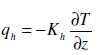
Soil heat flux
The soil heat transfer calculation is based on the one-dimensional heat transfer equation:
Network resistances
The fluxes between the nodes in the network are controlled by five resistances:
-
Aerodynamic resistance expresses the ability of the air to transport energy and water away from the canopy.
-
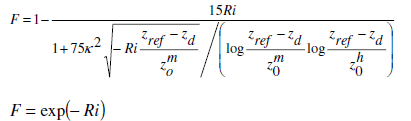
The stability number for unstable and stable atmospheric conditions (Ek and Mahrt 1991)
-
Resistance between soil surface and canopy air is parameterized as proposed by Choudhury and Monteith (1998)

-
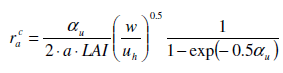
Leaf boundary layer resistance is according to Choudhury and Monteith (1998):
-
Stomata resistance using a Jarvis – type model (Jarvis 1976)
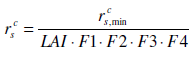
The reduction functions (F1 – F4) represent the influence of radiation, temperature, air humidity and soil moisture on the stomata resistance.