Simplified Macropore Flow (bypass flow)
1. Overview
Flow through macropores in unsaturated soil is important for many soil types. In the Unsaturated Zone module, a simple empirical function is used to describe this process. The infiltration water is divided into one part that flows through the soil matrix and another part, which is routed directly to the groundwater table (bypass flow).
The bypass flow is calculated as a fraction of the net rainfall for each UZ time step. The actual bypass fraction is a function of a user-specified maximum fraction and the actual water content of the unsaturated zone, assuming that macropore flow occurs primarily in wet conditions.
Thus, the bypass flow, \(Q_{bypass}\), is calculated as

Equation 31.29
where
- \(P_{net}\) is the net rainfall rate
- \(P_{frac}\) is the maximum fraction of the net rainfall which can bypass the matrix (under wet conditions).
- \(\alpha_{10}\) and \(\beta_{50}\) are used to reduce the total bypass fraction under dry conditions.
\(\alpha_{10}\) and \(\beta_{50}\) are calculated internally by MIKE SHE and depend on the actual water contents of the unsaturated zone 10cm and 50cm below the ground surface, respectively. The relationship used to calculate \(\alpha_{10}\) and \(\beta_{50}\) is illustrated in Figure 31.3. \(\alpha_{10}\) and \(\beta_{50}\) vary linearly between 0.0 and 1.0 when the water content is between \(\theta_2\) and \(\theta_1\). If the water content is below \(\theta_2\), \(\alpha_{10}\) and \(\beta_{50}\) equal 0.0. If the water content is above \(\theta_1\), \(\alpha_{10}\) and \(\beta_{50}\) equal 1.0.
Typically, macropore flow is highest in wet conditions when water is flowing freely in the soil (e.g. moisture content above the field capacity, \(\theta_{FC}\)) and zero when the soil is very dry (e.g. moisture content at the wilting point, \(\theta_{WP}\))
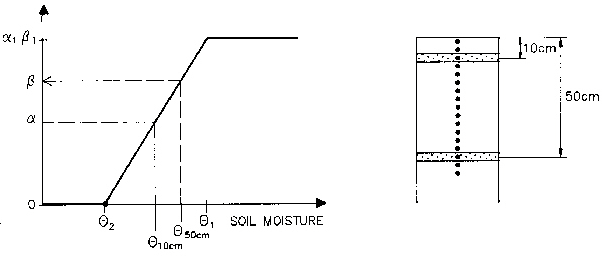
Figure 31.3 \(\alpha\) and \(\beta\) as a function of the soil moisture content 10 cm and 50 cm below the ground surface, respectively.
2. Adjustment for the 2-Layer Water Balance method
In the 2-Layer Water balance method, there are only two UZ layers. Thus, the calculation of \(\alpha_{10}\) and \(\beta_{50}\) is simplified somewhat, whereby \(\theta_{10}\) and \(\theta_{50}\) are respectively equal to
- the water content of the upper UZ layer, if they are located above the extinction depth,
- the water content of the lower UZ layer, if they are located below the extinction depth, but above the water table, and
- \(\theta_s\) if they are located below the water table.
For example, if the extinction depth was at 40cm and the water table at 60cm, then \(\theta_{10}\) would equal the water content of the Upper Layer and \(\theta_{50}\) would equal the water content of the Lower Layer.