MIKE ECO Lab
1. MIKE ECO Lab Template Specification
a. Overview
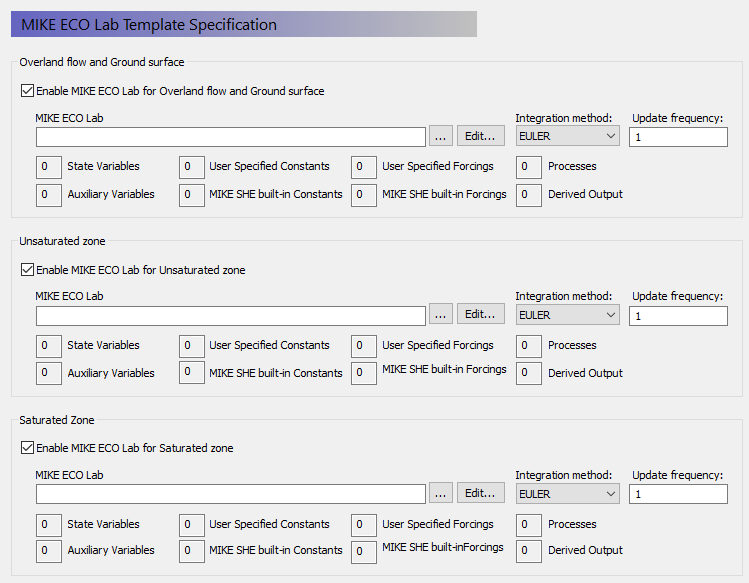
In the MIKE ECO Lab Template Specification dialog, there is a checkbox for each of the processes. These checkboxes are active if the Water Quality is activated for the process in the WQ Simulation Specification dialog. When you enable MIKE ECO Lab for the specific process, you will be able to browse to the required MIKE ECO Lab template. Specified templates can be directly modified by clicking on the Edit button.
 When you browse to a template, the template file is read by the Setup Editor and the number of components (i.e. State Variables, Forcings, Processes, etc.) that have been specified in the template are displayed in the Template summary.
Interpolation Method
When calculating the concentrations (State Variables) for the next time step, an explicit time-integration of the transport equations is made. Depending on the desired accuracy of this numerical integration, you can choose one of three different integration methods. The methods are in increasing level of accuracy (and numerical effort), starting with the Euler method and finishing with the Runge Kutta 5th Order method).
Update Frequency
For each template you can specify an update frequency. The update frequency tells MIKE SHE how frequently to call MIKE ECO Lab. If the water quality processes are slow relative to the simulation time step, you can save considerable simulation time by calling MIKE ECO Lab less frequently. For example, to call MIKE ECO Lab every second or third simulation time step, you would specify an Update frequency of 2 or 3.
Warning
All concentrations passed from MIKE SHE to MIKE ECO Lab are in units of [g/m3], which is equivalent to [mg/L].
Thus, all parameters and equations defined in the MIKE ECO Lab template must reflect these units - either directly or via an appropriate scaling factor. For example, the correct units for a decay rate constant might be [g/m3/day] or [mg/L/day].
Related Items:
- Working with MIKE ECO Lab in MIKE SHE - User Guide
- MIKE ECO Lab Overview Tables
- User Specified MIKE ECO Lab Constants and Forcings
- Advection Dispersion - Reference
b. MIKE ECO Lab Overview Tables
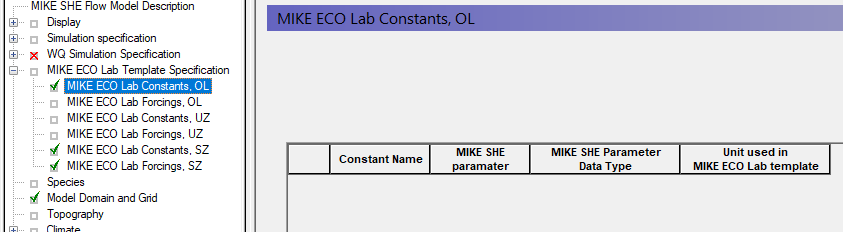
In the MIKE ECO Lab Template Specification data tree branch, there is a sub-branch for each of the active MIKE ECO Lab domains - Overland Flow, the Unsaturated Zone, and the Saturated Zone.
The tables are derived from the list of specified Constants and Forcings in the templates.
If the Forcing or Constant is not user defined (User Defined = “NO”), then the Forcing or Constant is an internal value in MIKE SHE and will be passed automatically to MIKE ECO Lab. The list of available parameters is quite short - primarily geometry related (e.g. cell volume), plus a few domain-specific constants (e.g. porosity). You must specify the MIKE SHE parameter to use and the EUM unit used in the template.
If the Forcing or Constant is user defined (User Defined = “YES”), then the Forcing or Constant must be specified explicitly in MIKE SHE. In this case, there is nothing to specify on the main list of Forcings and Constants, but a Forcing or Constant item is added to the data tree down under the appropriate branch in the data tree. In this branch you will find a table of user specified Forcings and Constants, plus individual sections for each item. Each item can be spatially defined similarly to other constants or time varying values in MIKE SHE.
Related Items:
- Working with MIKE ECO Lab in MIKE SHE - User Guide
- MIKE ECO Lab Template Specification
- User Specified MIKE ECO Lab Constants and Forcings
- Advection Dispersion - Reference
2. User Specified MIKE ECO Lab Constants and Forcings
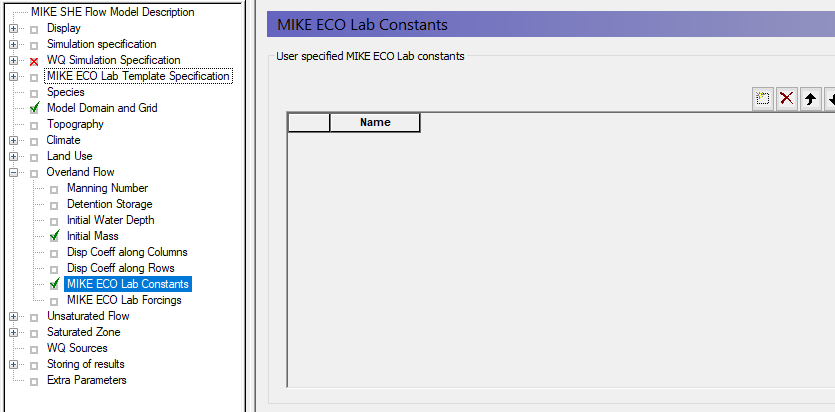
If the Forcing or Constant is user defined (User Defined = “YES”), then the Forcing or Constant must be specified explicitly in MIKE SHE.
In this case, a Forcing or Constant item is added to the data tree under the appropriate branch in the data tree. In this branch, you will find a table of user specified Forcings and Constants, plus individual sections for each item. Each item can be spatially defined similarly to other constants or time varying values in MIKE SHE.
Note
The Forcings and Constants are defined by Water Quality layer in the Saturated Zone. Thus, you have to define at least one Water Quality Layer in the Saturated Zone.